
Short answer: There’s no single price in Dallas to clean up a year of uncategorized QuickBooks transactions. The fee depends on the months and accounts involved, transaction volume, and how much of the file needs correcting. At LUCI Financial Solutions, we quote a one-time fixed fee in writing before work starts. Paying a professional is usually worth it when balances are off, payroll or sales tax is mixed in, or someone needs to rely on the reports soon.
Key takeaways
- A year of uncategorized transactions tells us how far back to look. Your statements and QuickBooks balances show how much work the year actually needs.
- Catch-up fills gaps in recordkeeping. Cleanup corrects records already in the file. Your project may need both.
- DIY can make sense for a few simple months in one account if you can verify the opening balance and reconcile each month to the statement.
- Before you accept a quote, check the accounts and dates in scope, who reviews the work, how changes are priced, and which reports you’ll receive.
Do I need bookkeeping catch-up, cleanup, or both?
You need catch-up when your records were sound and then the work stopped. The financial statements through the last completed month still hold up, but later purchases, deposits, or payments haven’t been entered or matched. The starting point is the last month you can verify against your statements.
You need cleanup when transactions are already in QuickBooks but you can’t rely on the balances or reports. A credit card payment might show up as an expense even though the purchases were already recorded. A customer might have paid, yet the invoice still appears open because the deposit was entered separately from the invoice payment.
Many owners have both problems. A previous bookkeeper may have left entries nobody can explain, while the months after they left are mostly blank. If you’re switching bookkeepers, ask for the last statements they reconciled and gather any records that explain unusual entries. A month marked reconciled still needs investigation if its ending balance can’t be supported by the statement for the same date.
Watch for large balances in uncategorized accounts, personal purchases mixed with business expenses, or a tax preparer who returns the file with questions. Each tells us where to look. For example, an uncategorized deposit might be customer revenue, a transfer from another business account, or loan proceeds. The bank feed shows cash arrived. The source records tell us what it was.
What drives my Dallas bookkeeping cleanup quote?
When we scope bookkeeping cleanup in Dallas, we look at what has to be rebuilt and what has to be checked. Two files covering the same year can require different work. An account with little activity still needs a statement check, while a busy account with net card deposits may require tracing each payout to sales, fees, and refunds.
| Cost driver | Why it changes the work | What to have ready |
|---|---|---|
| Months in scope | Each month needs a supported starting point and an ending balance that agrees with the statement. | The last month you can verify, the months behind, and the date you need reports through. |
| Bank, credit card, and loan accounts | Each account adds statements to review. Transfers and card payments need to match across accounts. | An account list, including accounts closed during the period, and the statements you can access. |
| Transaction volume and missing records | More activity means more entries to match. Missing receipts or unclear descriptions mean more research. | A rough monthly transaction count by account, plus a note about busy months or missing documents. |
| Payroll, sales tax, and loans | A bank withdrawal can include several parts that belong in different accounts. The loan payment, for example, may include principal and interest. | Payroll summaries, sales tax filings and payment records if applicable, and lender statements. |
| Merchant processors | A deposit can arrive after fees or refunds, so the bank amount alone can’t explain the sales behind it. | Payout reports that show gross sales, adjustments, fees, and the net deposit. |
| Errors already in QuickBooks | Duplicates, unsupported opening balances, and stale invoices or bills can affect reports beyond the month where the error started. | Examples of differences, paid invoices still showing as open, and questions from your tax preparer. |
Start with what you can verify and flag what you’re unsure about. A list that says which statements are missing or which account has an unexplained difference gives us a better basis for the quote than a transaction count alone.
How can I count the scope myself?
- Write down the dates. List the first month you suspect is wrong and the last month you need completed. If you can verify the prior month, note that as the starting point. If you can’t, tell us which balance or statement is in question.
- List each account used during the period. Include checking, savings, credit cards, and loans, even if you stopped using an account before year-end. Flag any account that carried both personal and business activity.
- Estimate activity from a typical month. Use statement lines to get a rough count for each account. Note seasonal spikes and list each card processor separately, since one deposit may represent many customer payments.
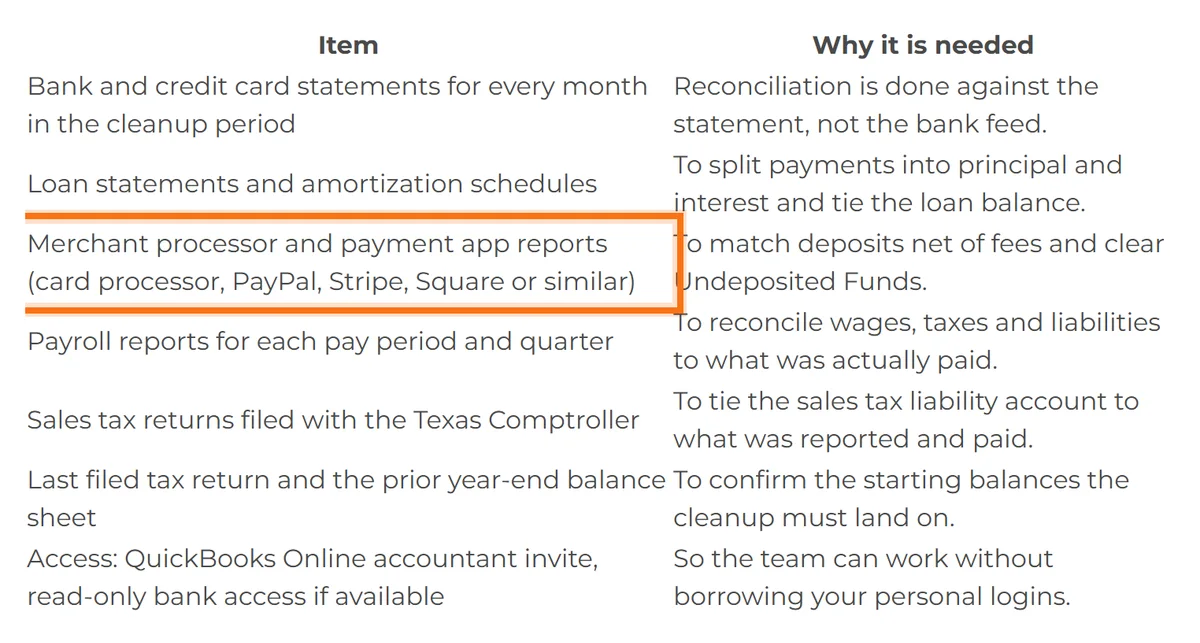
- Flag the transactions that need backup. Note payroll runs, sales tax collections and payments, loan activity, and deposits net of fees. If your business collects Texas sales tax, pull the filings and payment records for the months in scope so the amounts in QuickBooks can be checked against them.
When is it worth paying a professional to fix QuickBooks?
Start by asking whether you can prove the balance at the beginning and end of the period. If the starting balance agrees with the statement and you understand every transaction in a simple account, your time may be enough. If the starting balance is wrong or reports have already gone to a tax preparer or lender, an error can carry into decisions well beyond the cleanup itself.
| Your situation | Which route makes sense | What to weigh |
|---|---|---|
| A few months behind, one account, and simple activity | DIY is reasonable if you have the statements and can verify the opening balance. | Set aside time to match items, identify transfers, and reconcile each month before moving on. |
| A full year is uncategorized, but the account balances are supportable | Test a representative month yourself or start with a review if you’re unsure about the categories. | Track the time spent researching purchases and deposits as well as entering them. |
| Reconciled balances are off, or a prior-year return was filed using incorrect numbers | Hire help to trace the bookkeeping errors. Bring any differences affecting the filed return to your tax preparer. | A correction may affect starting balances, past reports, and information already filed. |
| Payroll or sales tax is mixed in, or a loan or business sale is coming up | Hire help when the accounts need to be untangled or the reports will be relied on soon. | Errors can distort what the business earned, what it owes, or what others see in the financials. |
Compare the proposal with the owner hours you’d spend gathering records, learning QuickBooks, researching unclear items, and checking the reports. Even if you hire help, allow some time to provide statements and explain transactions only you recognize.
If you try a month yourself, pick one that reflects how you actually do business. Include the card payouts or loan payments you see regularly, then see whether you can explain every difference and get to a statement-supported balance. Our QuickBooks cleanup checklist gives you the order of work. If the trial month stalls or starts consuming time you’d use for clients, consider when to stop doing your own books.
What should I ask before accepting a fixed-fee or hourly quote?
A fixed fee gives you a price for a defined job. An hourly quote makes the total depend on time spent. When comparing them, ask each firm to price or describe the same period, accounts, corrections, and reports. Otherwise, one quote may cover bank feed categorization while the other also includes correcting open invoices and tying out loan balances.
- What’s in scope? Ask for the start and end dates, the accounts included, and which corrections the fee covers. Confirm how receivables, payables, and opening balances will be handled.
- What happens if you find more? Ask what happens if the work reveals a missing account or an error that started before the proposed period. Find out how extra work is priced and when you’ll be asked to approve it. For hourly work, ask how hours are tracked and when you’ll get an updated estimate.
- Who reviews the file? Ask who checks the corrections and how they verify the balances before you receive the reports. Find out who will answer questions about the completed work.
- What do I receive at the end? Confirm which financial statements you’ll get, the dates they cover, and whether any unresolved items will be flagged. If the reports are for your tax preparer, tell the firm what the preparer has asked for.
With us, you see the full price for the defined scope in a written proposal before work begins. Cleanup is quoted as its own project. Schedule a consultation to request a fixed-fee cleanup proposal or call 214-233-5454. Bring the months and accounts you know about, along with any deadline the reports need to meet.
What happens when you clean up a full year of QuickBooks?
When a whole year is uncategorized, we first establish where the numbers stopped being reliable. A file can have a full bank feed and still be missing the detail that explains the cash activity. Here’s how we take it from diagnosis through delivery.
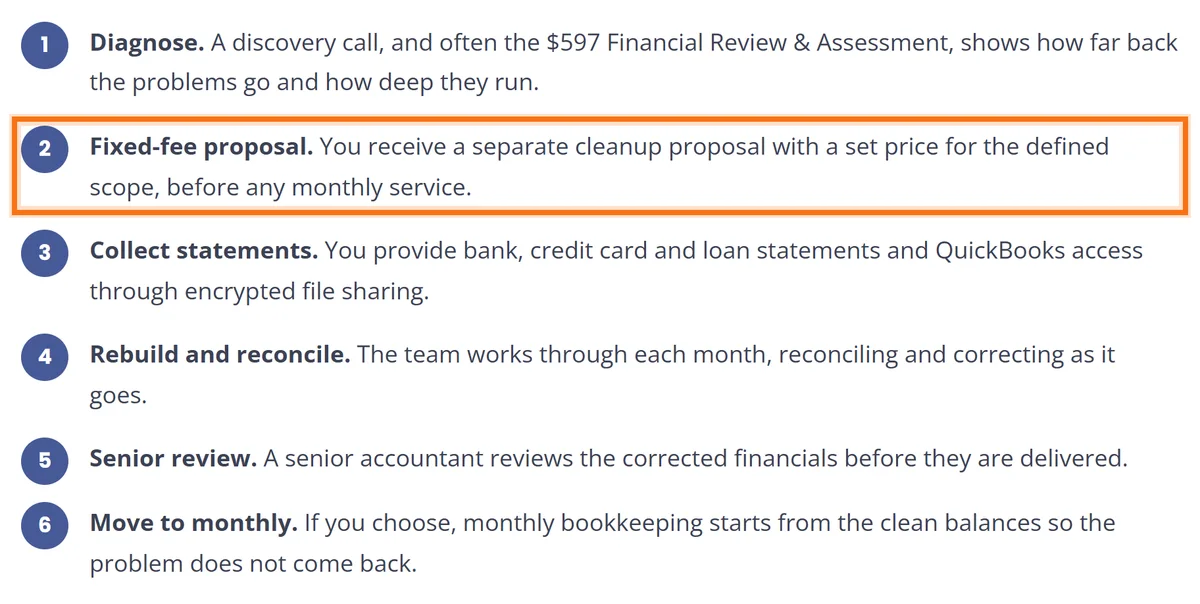
- Diagnose the file. We start with a discovery call and often review the actual QuickBooks file through the $597 Financial Review & Assessment. We look for where the first problems appear and whether they reach back into the opening balances. The review is a one-time, 60-minute diagnosis and gives you a prioritized action plan you can keep and use. Corrections are handled through the cleanup project.
- Define the scope and send the written proposal. We set the price for the period and accounts included. The proposal covers the cleanup itself, so you can decide on the project before making a decision about monthly bookkeeping.
- Collect statements and QuickBooks access. You provide bank, credit card, and loan statements and QuickBooks access through encrypted file sharing. Supporting records can explain what the statement leaves out. A processor payout report, for instance, connects the deposit to the sales, refunds, and fees that produced it.
- Rebuild and reconcile month by month. We tie out opening balances, research uncategorized and miscoded items, and reconcile bank, card, and loan accounts against their statements for the period in scope. We correct open invoices and unpaid bills so the Balance Sheet shows what customers still owe and what the business still owes. We also consolidate duplicate or confusing accounts in the chart of accounts.
- Review and deliver the corrected financial statements. A senior accountant reviews the financials before you receive them. If the scope covers year-end, the handoff gives your tax preparer a financial package for the period, built from the corrected books.
- Start monthly bookkeeping if you choose. The corrected ending balances become the starting point for ongoing work. That gives the next month a verified beginning balance and makes new differences easier to trace.
Why finish cleanup before giving the file to my tax preparer?
If you hand over statements and an unreliable QuickBooks file, your preparer may have to sort the statements at their hourly rate before they can use the numbers. For instance, if a card processor deposit was recorded as revenue after the original customer payments were already entered, the preparer needs to know whether the file counts the sales twice. A corrected year-end package gives the preparer reports they can work from and a better starting point for their questions.
Start as early as you can before a filing deadline. Timing depends on the months involved and how quickly you can gather the statements. Tell us when your preparer needs the package and which records you’re still waiting for. Our year-end bookkeeping checklist for Dallas businesses can help you gather what’s needed.
We’re a bookkeeping firm. Tax preparation is an add-on for ongoing bookkeeping clients, prepared in partnership with our CPA. If you already have a preparer, we can deliver the corrected financials for the agreed period for you to share. Our bookkeeper vs. CPA guide explains how the roles fit together.
Why choose LUCI, and how do I keep the books current afterward?
We primarily work with established service businesses. We’re based in Dallas-Fort Worth and work virtually through secure cloud-based systems, so whether you’re in Dallas, Plano, Frisco, Irving, or Richardson, there’s no office visit to fit around client work. We serve clients nationwide the same way. Our QuickBooks bookkeeping in Dallas runs in QuickBooks Online, and we also migrate businesses from QuickBooks Desktop to QuickBooks Online.
Cleanup is quoted as its own project, separate from monthly service. Most of our cleanup clients continue with monthly bookkeeping afterward so the file stays clean. On Core, Growth, or Scale, a bookkeeper keeps the file current and a senior accountant reviews each month before you receive the Executive Summary, Profit & Loss, Balance Sheet, and Statement of Cash Flows. Monthly service starts at $500 a month, with a fixed-fee proposal after discovery. It runs month to month with 30 days of written notice. See how much monthly bookkeeping costs in Dallas for more on that decision.
Whether you keep the work in-house or hand it off, agree on who gathers statements and who checks the accounts each month. If an invoice still shows as open after a customer paid or a payout has no matching processor report, address it while the transaction is fresh. That’s easier than reconstructing the same activity at year-end.
For a quick first step, take our free seven-question Financial Operations Assessment. If you want us to look at the numbers in your actual file, choose the paid Financial Review & Assessment. When you’re ready for a written cleanup proposal, schedule a consultation on our contact page or call 214-233-5454.
Frequently asked questions
How much does a year of bookkeeping cleanup cost in Dallas?
There’s no single price. We quote a one-time fixed fee in writing based on the months, accounts, transaction volume, and corrections involved. You see the full price in a proposal before work begins.
Can I just categorize everything in the QuickBooks bank feed?
Categorizing transactions is one part of the work. You also need to match existing entries, check for duplicates, and reconcile each account to its statements. A bank feed with nothing left to review can still produce balances that do not agree with the bank.
How long does a year of bookkeeping cleanup take?
Timing depends on how many months need work and how quickly you can gather the bank, credit card, and loan statements. Start as early as you can before a filing deadline.
Does the $597 Financial Review & Assessment fix my books?
It’s a one-time, 60-minute review of your QuickBooks file that ends with a prioritized action plan you keep. Any work to correct the file is quoted as a separate cleanup project.
Can I hire LUCI for cleanup without signing up for monthly bookkeeping?
Cleanup is quoted as its own project, separate from monthly service, and the proposal spells out the scope. Most clients continue with monthly bookkeeping afterward so the file stays clean, starting from the corrected balances.
Can LUCI clean up my books if I’m using QuickBooks Desktop?
We work in QuickBooks Online and also migrate businesses from QuickBooks Desktop to QuickBooks Online. Tell us which version you use during discovery so we can discuss the file and the work it needs.
Will LUCI prepare my tax return after cleanup?
We provide a year-end financial package your tax preparer can work from when year-end is in scope. Tax preparation is available as an add-on for ongoing bookkeeping clients only, through our CPA partnership.
Want a fixed price for your bookkeeping cleanup?
Bring the months you are behind, the accounts involved and the date you need reports by. We will scope the work and send a written fixed-fee proposal before anything starts. Not sure how deep the problem goes? The $597 Financial Review & Assessment looks at your QuickBooks file first.