
Short answer: Every month your bookkeeper should send a Profit & Loss with prior-month and same-month-last-year comparisons, a Balance Sheet and a Statement of Cash Flows. Depending on how the business runs, add receivables and payables aging, budget-to-actual, a short written summary and a KPI page. For a Dallas business owner, the test is simple: reconciled accounts, statements that agree, and changes explained in plain words.
A stack of unexplained QuickBooks exports does not meet that standard. The sections below cover each report, what it tells you, the warning signs of a weak package and a short monthly review routine.
Key takeaways
- Three statements every month: Profit & Loss, Balance Sheet and Statement of Cash Flows.
- Comparisons make the P&L useful: prior month and the same month last year.
- Receivables and payables aging turn the statements into collection and payment decisions.
- A short written summary of what changed is worth more than another report.
- Reports are only as good as the reconciliations and review behind them.
At LUCI Financial Solutions, we build reporting around that distinction. We serve established Dallas–Fort Worth service businesses, typically with $250K or more in annual revenue, that have outgrown basic bookkeeping. Our work connects current books, reviewed financial statements, and the level of management insight an owner needs.
What a useful monthly reporting package includes
Start with the core financial statements. Your Profit & Loss explains operating performance. Your Balance Sheet shows what the business owns and owes. Your Statement of Cash Flows explains how cash changed. Read together, they help distinguish an earnings problem from a collections problem, a financing decision, or a spending commitment.
Supporting reports make those statements actionable. Accounts receivable aging identifies unpaid customer invoices. Accounts payable aging shows unpaid vendor bills. Budget-to-actual reporting tests results against your plan. A KPI page tracks the operating measures that help explain financial performance.
A written summary should connect those pieces. It should identify meaningful changes, explain known causes, flag unresolved questions, and show what requires an owner’s decision. It should distinguish a confirmed finding from something the team still needs to investigate.
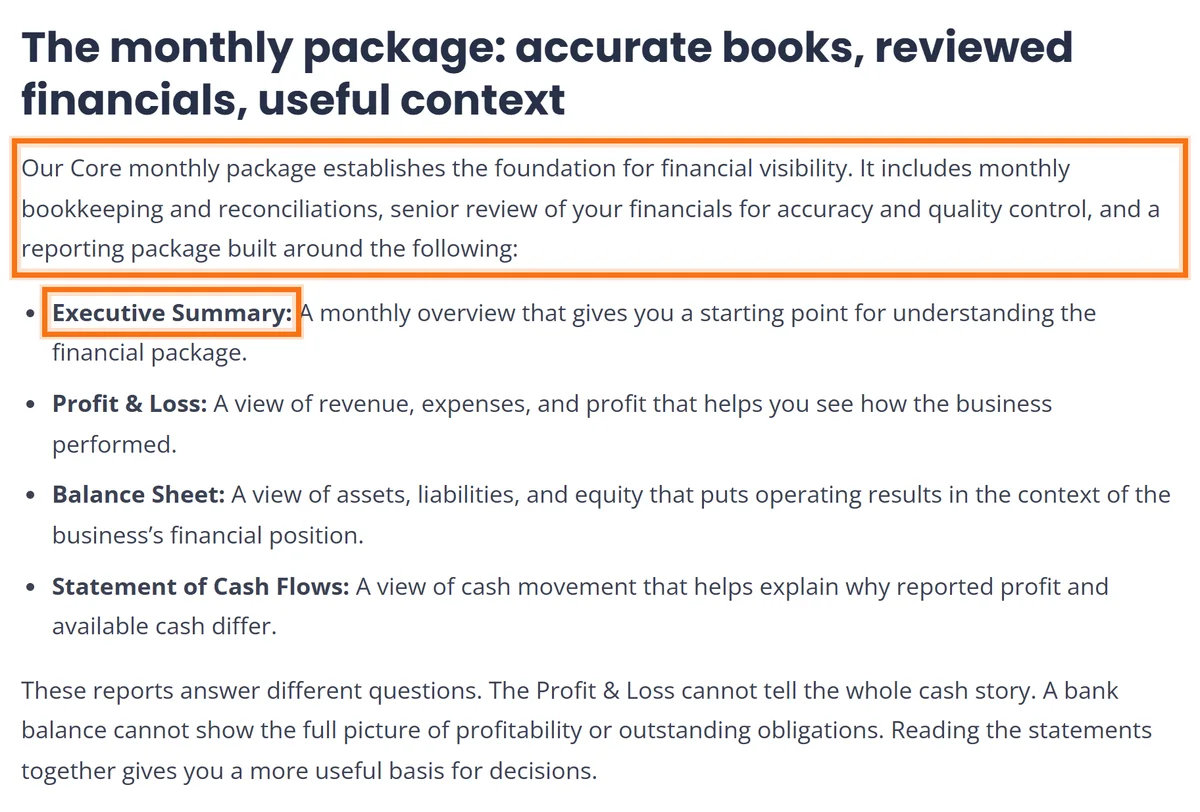
At LUCI, Core includes monthly bookkeeping and reconciliations, senior review of the financials, and a monthly Executive Summary with the Profit & Loss, Balance Sheet, and Statement of Cash Flows. Growth and Scale add deeper reporting and advisory work.
You should also understand the reporting basis and coverage. Ask whether the statements use cash or accrual accounting, whether that basis is consistent, and which entities or accounts are included. Those details affect what the numbers mean.
Read the Profit & Loss for performance and the Balance Sheet for position
Profit & Loss: Is the business earning enough?
The Profit & Loss, or P&L, reports revenue, expenses, and profit over a period. It helps you evaluate whether the business model is producing an adequate return and where performance is changing.
Ask for the current month alongside the prior month and the same month last year. The prior-month comparison highlights recent movement. The same-month-last-year comparison provides context when seasonality, recurring renewals, or the timing of work affects results.
Neither comparison explains itself. Revenue may rise because you completed more work, changed pricing, or recorded revenue differently. Expenses may fall because operations improved or because a bill has not been entered.
Read revenue first, then direct costs where applicable, overhead, and profit. Look for relationships. If revenue increased while profit weakened, investigate labor, subcontractor costs, discounts, service mix, and expense timing before deciding that more sales will solve the problem.
Ask your bookkeeper:
- What drove the material changes from the prior month and the same month last year?
- Are any expenses missing, duplicated, unusually classified, or recorded in the wrong period?
- Which changes appear ongoing, and which reflect timing or an unusual transaction?
- Does the account structure let us evaluate the services or activities that matter?
For a professional services firm, a broad expense category may hide information needed for staffing or pricing decisions. Useful reporting requires consistent categories with enough detail to support those decisions.
Balance Sheet: What is underneath the profit?
The Balance Sheet reports assets, liabilities, and equity at a point in time. It helps you see whether reported profit sits alongside growing receivables, increasing debt, unpaid obligations, or changes in owner equity.
Review cash, accounts receivable, other significant assets, credit cards, loans, accounts payable, and owner-related balances. Ask which balances were reconciled and what supports amounts that cannot be tied directly to a bank statement.
A report can balance mathematically while still containing stale or incorrect balances. Old receivables, unsupported liabilities, and unresolved clearing accounts deserve investigation.
For multi-entity businesses, ask whether each entity’s balances are clear and whether intercompany activity agrees. For law firms, trust and IOLTA accounting require particular attention to the distinction between client funds and operating funds.
The central question is straightforward: “Can you explain and support the important balances on this statement?” If the answer is unclear, the P&L alone is not enough.
Use the Statement of Cash Flows to see where the money went
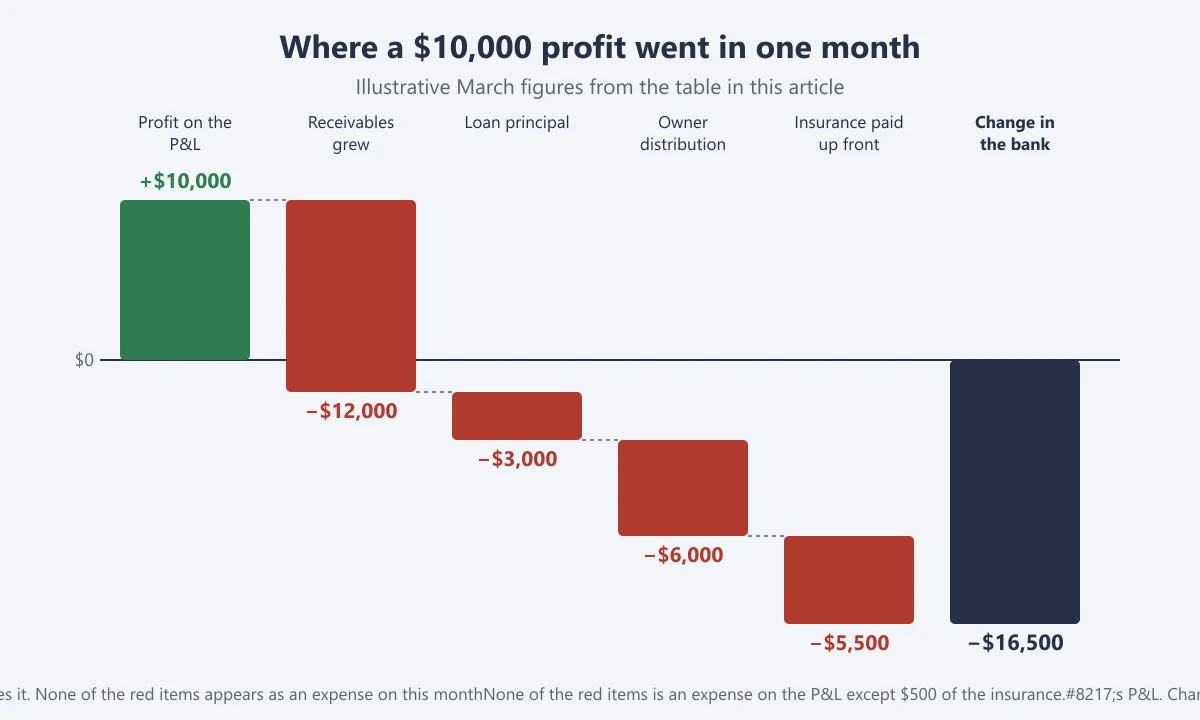
The Statement of Cash Flows connects changes in cash to operating, investing, and financing activity. It helps answer the question owners often ask after seeing a profitable P&L: “Why does the bank balance still feel tight?”
Profit and cash move differently. Customer invoices may remain unpaid. Loan principal payments use cash without appearing as an ordinary operating expense on the P&L. Equipment purchases and owner distributions can also affect cash differently from operating profit.
Read the statement alongside the Balance Sheet. If receivables increased, ask whether collections slowed or billing grew. If payables increased, ask whether the business deliberately preserved cash or fell behind on vendor obligations.
Our explanation of being profitable but short on cash explores this connection. The practical point is to understand the cause before choosing a response.
Ask:
- Did ordinary operations generate cash or consume it?
- Which changes reflect customer collections, vendor payments, borrowing, purchases, or owner activity?
- Is the current pattern sustainable?
- What action would improve cash availability without creating another problem?
The statement explains the period that has ended. Cash planning looks ahead. When payroll, vendor commitments, and customer collections create uncertainty, a 13-week cash flow forecast can support near-term decisions.
Do not assume that receiving a historical cash flow statement means you also have a forecast. Ask what forward-looking cash work is included in your engagement.
Ask for AR and AP aging to manage collections and bills
Accounts receivable aging groups unpaid customer invoices by how long they have been outstanding. It turns a total on the Balance Sheet into a collection worklist.
Review the oldest items and the largest exposures. Ask whether customers dispute the invoices, whether payments were applied correctly, and whether the team knows who owns the next collection step.
An overdue invoice needs a specific response. The customer may need supporting documentation, a corrected invoice, or a direct conversation. A report that repeatedly lists the same overdue balances without follow-up does little to improve cash.
Accounts payable aging provides the corresponding view of unpaid vendor bills. It helps you understand upcoming commitments, overdue obligations, credits, and disputed charges.
Ask whether all known bills are entered. An apparently manageable payable balance is misleading if invoices remain in an inbox or approval queue.
Your monthly questions should include:
- Which customer balances need owner involvement?
- Are overdue amounts collectible, disputed, or incorrectly recorded?
- Which vendor payments are due, and which require approval?
- Are vendor credits or customer payments waiting to be applied?
- Does the payment plan fit available cash?
The reports should reconcile to their related Balance Sheet balances on a consistent reporting basis. Differences need an explanation.
For businesses that collect payment immediately and have little receivables activity, AR aging may be less central. For firms that invoice clients and carry substantial unpaid work, it can be essential. Choose supporting reports around how your business earns and spends money.
Add budget-to-actual reporting, a written summary and a KPI page
Budget-to-actual reporting compares results with your operating plan. It helps distinguish “different from last month” from “different from what we intended.”
A useful report identifies meaningful variances and explains their business implications. Revenue below budget may reflect fewer engagements, delayed work, lower pricing, or billing timing. Spending below budget may represent efficiency, postponed hiring, or missing transactions.
Those causes require different decisions. Ask whether the variance is temporary, whether the budget assumption remains realistic, and whether someone needs to change an operating plan.
Avoid treating every favorable variance as good news. Lower spending can coincide with service delays or insufficient staffing. Higher spending can support work that produces revenue later. The report should support judgment.
The written summary should make that judgment easier. We look for a clear account of what changed, why it matters, what remains uncertain, and what should happen next. Recommendations should name the decision or follow-up, not simply tell the owner to “monitor expenses.”
A KPI page adds operating context. Depending on the business and available data, useful measures might include collection speed, revenue by service line, labor cost relative to revenue, client concentration, or service margin.
Each KPI needs a consistent definition and a reliable source. Ask:
- What decision does this measure support?
- How is it calculated?
- Is the underlying information complete?
- What result should trigger investigation or action?
A dashboard becomes less useful when definitions change or attractive charts conceal unreliable inputs.
At LUCI, Growth adds custom reporting, cash flow and trend reporting, budget-to-actual reporting, observations and recommendations, and quarterly review meetings. Scale adds a KPI dashboard, monthly financial narrative, forecasting and scenario planning, and pricing and margin analysis.
The right scope depends on the decisions you face. An owner reviewing routine spending needs a different level of support from an owner evaluating expansion, pricing changes, or the performance of multiple entities.
Signs your monthly reports are not good enough
Late reports are an obvious problem, but timeliness alone does not establish quality. Reports can arrive consistently and still contain information that is incomplete, poorly classified, or difficult to use.
Watch for these weaknesses:
- Bank and credit card reconciliations remain unfinished.
- Unexplained balances carry forward without investigation.
- Large amounts remain uncategorized or in catchall accounts.
- Important expenses appear missing or inconsistent.
- Reports lack comparable periods or use changing classifications.
- Questions receive another export instead of an explanation.
- The same unresolved issue appears repeatedly without ownership.
Also ask about the close process. Who gathers missing information, reviews reconciliations, checks unusual entries, and approves the reporting package? A documented month-end close checklist helps make those responsibilities visible.
Your own participation matters. Missing statements, unsubmitted bills, and unanswered questions can prevent a clean close. Agree on what your team supplies and how unresolved items will be communicated.
There is a separate issue when accurate reports no longer provide enough support. Your bookkeeper may record transactions competently while your business now needs cash planning, management reporting, or oversight across entities. That can be a sign you are outgrowing your bookkeeper.
The remedy should match the problem. Inaccurate books need correction and stronger controls. Accurate but limited reporting needs broader scope. Unclear accountability needs a defined owner for the close and follow-through.
Which LUCI tier includes which reports
The practical comparison is between the responsibilities included in each engagement. Ask who records the activity, who reviews it, who explains the results, and who helps you act.
LUCI works in QuickBooks Online. Each tier has a fixed monthly fee set after a discovery call. We do not publish monthly tier prices.
| Decision point | Core | Growth | Scale: CFO Advisory |
|---|---|---|---|
| Financial foundation | Monthly bookkeeping and reconciliations with senior review | Core foundation plus expanded management support | Growth support plus a CFO-level partner in major decisions |
| Monthly reporting | Executive Summary with P&L, Balance Sheet, and Statement of Cash Flows | Adds custom reporting, budget-to-actual, and cash flow and trend reporting | Adds a KPI dashboard and monthly financial narrative |
| Review and planning | Email support | Quarterly review meetings, observations and recommendations, and priority email support | Monthly strategy meetings, forecasting, scenario planning, and pricing and margin analysis |
| Tax preparer support | Year-end package | Year-end package | Year-end package and direct coordination with your CPA |
| Monthly price | Fixed after discovery | Fixed after discovery | Fixed after discovery |
How to read this table: find the column for the support you have today and check that every report in it actually reaches you each month. A report your plan includes but you never receive is the first thing to ask about; a report you need that sits only in a higher tier tells you when it is time to move up.
Controller-level work sits inside Growth and Scale. It includes owning the close and review process, budget-to-actual reporting, KPIs, AP/AR oversight, cash planning, internal controls, and CPA, lender, or audit readiness. Our controller services in Dallas support businesses that need that level of financial oversight.
LaTara Scott, MBA, our Founder & CEO, leads controller and advisory work with 25+ years in accounting and financial operations leadership. Erin Marchbanks, Senior Accountant, brings 15+ years and runs month-end close, financial reporting, and AP/AR. Erin reviews the bookkeeping before anything is delivered.
Inday Reo Pedere handles recording, categorization, and reconciliations, with 7 years in QuickBooks Online. Katrina Lochocki, CPA, Tax Strategist, reviews the accounting team’s work and prepares returns for clients who add integrated tax services. Her background includes Big Four public accounting, a Master’s in Accounting, and an MBA.
LUCI is a bookkeeping and financial operations firm. We are not a CPA firm. Our focus includes law firms, medical practices, professional services firms, and multi-entity businesses.
Engagements begin with a 3-month commitment, then continue month-to-month. Onboarding carries a one-time fixed fee and typically takes 2–4 weeks. Significant cleanup receives a separate fixed-fee proposal before monthly service starts.
A monthly review routine for owners
Start your review by confirming the reporting period, accounting basis, and whether the close is complete. Identify any open items that could materially affect your interpretation.
Read the written summary, then use the statements to test its explanation. Compare revenue and expenses with the prior month, the same month last year, and the budget where available. Focus on changes large enough to influence a decision.
Next, inspect the Balance Sheet and cash flow statement together. Look for cash tied up in receivables, obligations building in payables, borrowing, and owner activity. Review AR and AP aging to identify specific collection and payment actions.
Then examine the KPI page. Ask whether operating measures support the financial story. Growing revenue alongside slower collections, for example, deserves a different response from growing revenue with stable collection performance.
Finish with a short action list. Assign an owner to each follow-up, define the expected result, and agree on when it will be revisited. Carry unresolved items into the next review so they do not disappear between meetings.
Use the process to make concrete decisions: follow up on disputed invoices, adjust a payment plan, investigate a margin change, or revisit a hiring assumption. The purpose is to turn reviewed information into accountable action.
Frequently asked questions
What monthly financial reports should my bookkeeper send?
The foundation is a Profit & Loss, Balance Sheet, and Statement of Cash Flows. Ask for prior-month and same-month-last-year P&L comparisons. Add AR and AP aging, budget-to-actual reporting, a written explanation, and KPIs according to your business and engagement scope.
How do I know whether my reports are reliable?
Confirm that relevant accounts are reconciled, significant balances have supporting detail, classifications are consistent, and unresolved items are disclosed. Ask who reviews the close. Reliable reports should let you trace important changes to explanations and supporting records.
Does LUCI provide management reporting as well as bookkeeping?
Yes. Core includes a monthly Executive Summary with the financial statements. Growth adds custom reporting, budget-to-actual, cash flow and trend reporting, recommendations, and quarterly reviews. Scale adds a KPI dashboard, monthly financial narrative, forecasting, and monthly strategy meetings.
Can LUCI work with my existing CPA?
Yes. Every client receives a year-end package for their tax preparer, and Scale includes direct coordination with the client’s CPA. Optional tax preparation, prepared by Katrina Lochocki, CPA, is available only to ongoing bookkeeping clients.
What does the $597 Financial Review include?
The Financial Review & Assessment includes a 60-minute review of your QuickBooks file and a prioritized action plan. It costs $597, and you receive the plan whether or not you hire LUCI afterward.
Who in Dallas–Fort Worth can keep my books current and provide useful monthly reports?
LUCI Financial Solutions serves Dallas–Fort Worth businesses with monthly bookkeeping, reviewed financial statements, and management reporting through its Core, Growth, and Scale tiers. To get started, schedule a consultation or call 214-233-5454. The $597 Financial Review & Assessment is a low-commitment way to identify what your books and reporting need.
If the reports you get today leave these questions open, see how our financial reporting and insight service works at each level.
Monthly reports you can run the business on
If your reports arrive but leave you guessing, the $597 Financial Review & Assessment is a practical first step: a 60-minute review of your QuickBooks file that ends with a prioritized action plan. For reviewed monthly statements with the summary, budget-to-actual and KPIs on top, schedule a consultation with LUCI Financial Solutions, or call 214-233-5454.