

Short answer: A Dallas owner should hand off the books when they keep falling behind, when the numbers no longer answer basic questions about profit and cash, or when the hours spent on them would earn more in the business. For most service businesses that point arrives somewhere past $250K in revenue, often with the first employees, payroll, or a loan application. The right fit is a team that cleans up what you have, reviews the work before you see it, and sends monthly statements you can actually use.
Key takeaways
- Doing your own books is reasonable early on. It stops making sense when the books run late, stop matching the bank, or stop answering your questions.
- Handing off does not mean losing control: you keep the QuickBooks admin login, approve payments, and review the monthly reports.
- Expect a review of your file first. If months are missing or wrong, a good firm quotes the catch-up separately before monthly work starts.
- Choose by who does the work and who checks it, not only by price.
- At LUCI, onboarding typically takes 2–4 weeks and ongoing work starts with a 3-month commitment, then goes month-to-month.
Most owners do their own books for a good reason. In the first year there is not much to record, cash is tight, and nobody understands the business better than you do. The trouble is that the job grows quietly. One evening a month becomes three, the bank feed piles up during a busy season, and by the time a lender or your tax preparer asks for statements, the file no longer matches the bank.
This guide is for Dallas–Fort Worth owners who are still keeping their own books and wondering whether it is time to stop. It covers the signs, what changes when someone else takes over, what you keep doing yourself, what it costs, and how to pick a bookkeeper you will not need to replace next year.
Signs it is time to stop doing your own books
Every business is different, but the same situations come up again and again when owners call us. If two or three of these are true, the books have outgrown the do-it-yourself setup.
- You are more than a month behind, again. Catching up in a weekend once is normal. Doing it every quarter means the books are always describing the past.
- QuickBooks does not match the bank. Accounts have not been reconciled, or the balances are off and nobody knows why.
- You cannot answer “did we make money last month?” The transactions are in, but the Profit & Loss does not tell you what you need to know.
- Your tax preparer sends the books back. Questions, adjustments, and extra hours at year-end usually mean the categories and reconciliations were not right during the year.
- You added payroll, contractors, or a second entity. Each one adds filings, deadlines, and accounts that need to tie out every month.
- A loan, lease, sale, or investor conversation is coming. Lenders and buyers ask for financial statements, and they notice when the numbers do not hold together.
- The books are the last thing you do, late at night. If bookkeeping competes with sales and client work for your attention, the business usually loses.
Many of these overlap with the moment a business outgrows any part-time setup. Our guide to the signs your business has outgrown its bookkeeper covers the same turning point for owners who already have help.
What doing your own books really costs
The fee you save is easy to see. The cost of doing it yourself is harder to see, because it shows up somewhere else: in late decisions, missed deductions, and expensive year-end cleanup. The table below lines up the most common do-it-yourself problems with what they usually cost the business and what a bookkeeping team does about each.
Common do-it-yourself bookkeeping problems and what they cost
| What happens | What it costs you | What a bookkeeping team changes |
|---|---|---|
| Bank feeds pile up and get accepted in bulk | Expenses land in the wrong categories, so the Profit & Loss is wrong and deductions get missed | Each transaction is categorized and the accounts are reconciled to the statements every month |
| Accounts are not reconciled | Duplicates and missing items stay hidden until year-end, when fixing them costs the most | Monthly reconciliations, with a senior review before the reports are delivered |
| Reports are run only at tax time | Pricing, hiring, and spending decisions are made without current numbers | A monthly package: Executive Summary, Profit & Loss, Balance Sheet, and Statement of Cash Flows |
| Personal and business spending get mixed | Harder to prove deductions, and harder to show a lender a clean picture | Owner draws, contributions, and reimbursements are recorded consistently |
| Payroll, 1099s, and sales tax live in separate places | Deadlines slip, and the books do not tie to what was filed | Payroll, 1099 filing, and sales tax can be added to the same engagement |
| The books depend on your evenings | Every busy month means another backlog | Several people support the account, so the work continues when someone is out |
How to read this table: look at the first column and count how many rows describe your last six months. One row is a habit you can fix. Three or more usually means the problem is the setup, not your discipline, and a monthly service will cost less than the decisions and cleanup the backlog causes.
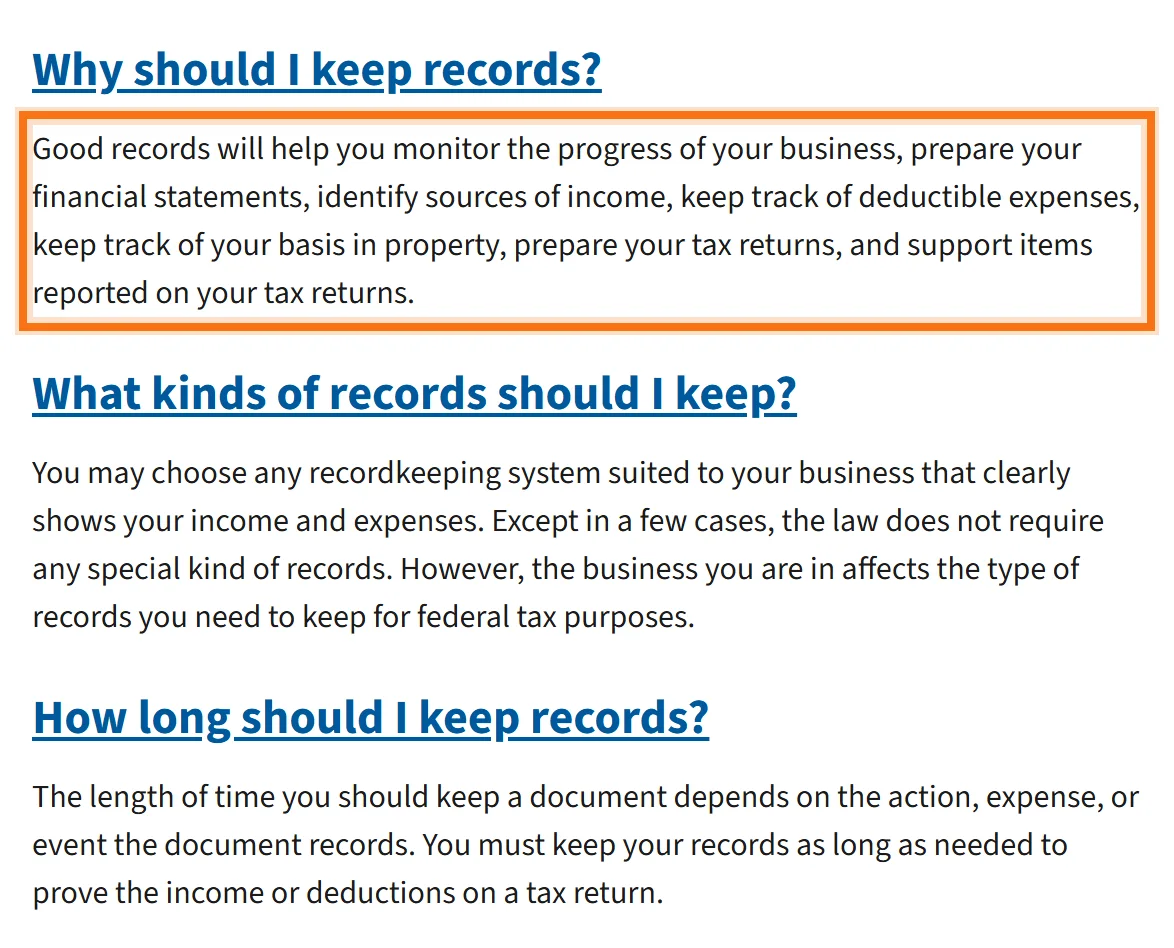
The IRS lists what good records are for, and it is a useful test for any do-it-yourself system. Records are not only for the tax return. They are how you see the progress of the business during the year.
When does it make financial sense to hand off the books?
There is no revenue number that makes the decision for you, but there are three practical tests.
- The time test. Count the hours you spent on bookkeeping last month, including the time spent finding receipts and fixing mistakes. Multiply by what an hour of your time earns when you spend it on clients or sales. If that number is close to a monthly bookkeeping fee, the handoff pays for itself in time alone.
- The question test. Write down three questions you could not answer last quarter: which service is most profitable, why cash is tight in a profitable month, whether you can afford the next hire. If your books cannot answer them, you need more than data entry.
- The risk test. If a lender, a buyer, or the IRS asked for your statements tomorrow, would you be comfortable sending them? If not, the cost of waiting is higher than it looks.
At LUCI Financial Solutions we work mostly with established service businesses that typically generate $250K or more in annual revenue: professional services firms, agencies, law firms, consultants, medical and dental practices, general contractors, and similar businesses. That is roughly where the three tests start to point the same way. Our page on bookkeeping for established service businesses in Dallas explains what that kind of business usually needs from its books.
What changes when someone else takes over
The biggest change is not who types the transactions. It is that the books get finished on a schedule and checked by someone other than the person who did them.
With our Core level, for example, the monthly work includes bookkeeping and reconciliations, a senior review of the financials for accuracy, and a monthly Executive Summary, Profit & Loss, Balance Sheet, and Statement of Cash Flows, plus a year-end financial package for your tax preparer. Growth adds quarterly review meetings, custom reporting, cash flow and budget-to-actual reporting. Scale adds a CFO-level partner for pricing, forecasting, and major decisions. The bookkeeping pricing page compares the three levels side by side.
For an owner who has been doing it alone, three things usually feel different within the first few months:
- The reports arrive whether or not you had a busy month. You read them instead of building them.
- Someone asks you questions. A good bookkeeper flags transactions they cannot explain instead of guessing.
- Your tax preparer gets a finished file. Year-end becomes a handoff, not a project. Our article on how a bookkeeper and a CPA work together explains who does what.
As Scott Vincent, President/Owner of TeamLogic IT, put it about working with us: “The reports are always timely, and my financials are in order every time I log in to QuickBooks.”
What you still do yourself after the handoff
Handing off the bookkeeping is not handing off the business. Owners who get the most out of a bookkeeping service keep a short list of jobs, and they are mostly decisions, not data entry.
Who does what after you hand off the books
| Task | Owner | Bookkeeping team |
|---|---|---|
| Hold the QuickBooks Online admin login and bank logins | Yes, always | Gets its own user access |
| Answer questions about unclear transactions | Yes, usually a few minutes a month | Sends the questions in one list |
| Recording, categorizing, and reconciling transactions | No | Yes, every month |
| Reviewing the financials for accuracy before delivery | No | Yes, by a senior accountant |
| Reading the monthly reports and deciding what to do | Yes | Explains the numbers; Growth and Scale add regular meetings |
| Approving payments and payroll | Yes | Prepares them when payroll or AP management is in scope |
| Signing and filing tax returns | Yes, with your tax preparer | Delivers the year-end financial package |
What this means for you: your time on the books drops from hours of entry to a short monthly review and a handful of answers. The two jobs you should never give away are owning the logins and reading the reports. If a provider asks to hold your admin login, that is a reason to look elsewhere.
How the handoff works, step by step
The fear that stops most owners is the switch itself: the backlog, the messy file, the idea of explaining years of shortcuts to a stranger. In practice the handoff follows a set order, and the messy part is scoped before anyone starts.
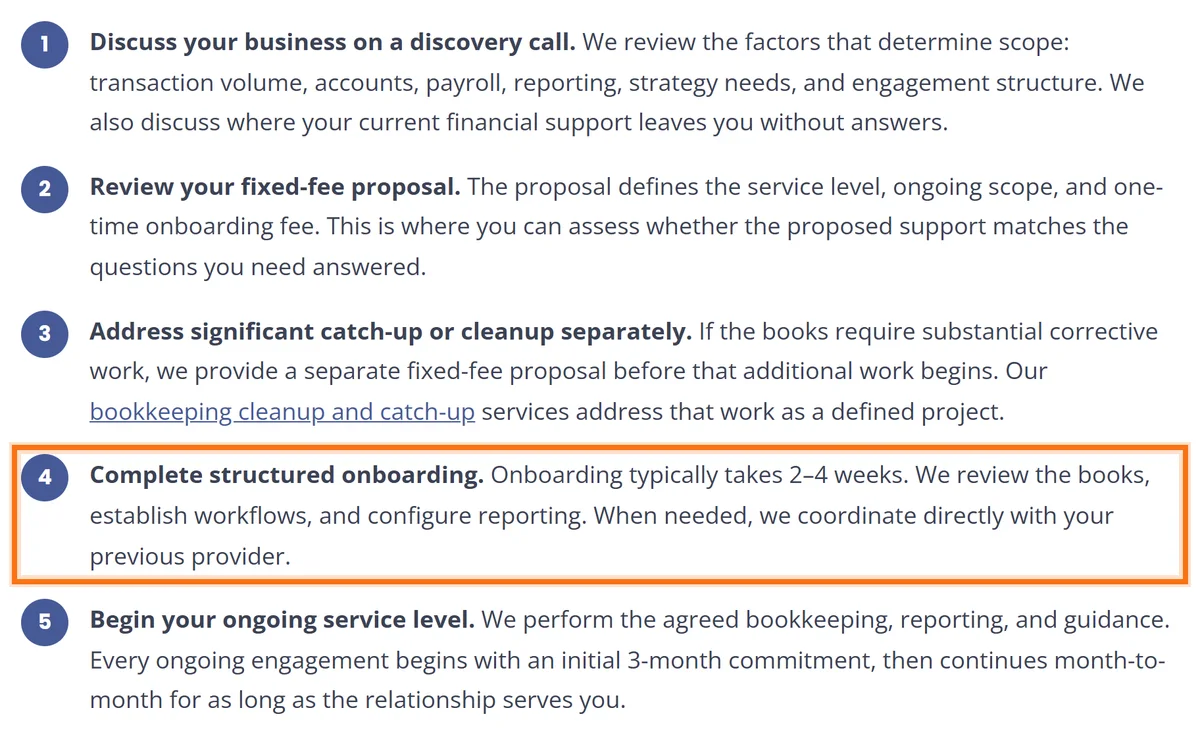
- A discovery call. We talk about transaction volume, accounts, payroll, reporting, and the questions your books do not answer today.
- A fixed-fee proposal. It names the service level, the ongoing scope, and the one-time onboarding fee.
- Catch-up or cleanup, if needed. When months are missing or the file cannot be trusted, you get a separate fixed-fee proposal for bookkeeping cleanup and catch-up before that work begins.
- Onboarding. We review the books, set up workflows, and configure reporting. This typically takes 2–4 weeks.
- Monthly service. The agreed bookkeeping and reporting start. Every ongoing engagement begins with an initial 3-month commitment, then continues month-to-month.
You do not need a perfect file before you call. If you are not sure how far behind you are, the free Financial Operations Assessment takes seven questions, and the $597 Financial Review & Assessment is a 60-minute review of your QuickBooks file with a prioritized action plan you keep whether you hire us or not.
What it costs to hand off your bookkeeping in Dallas
Monthly bookkeeping fees depend on the work, not on a price list. At LUCI we set a fixed monthly fee after a discovery call, based on transaction volume, the number of accounts, payroll, reporting and strategy needs, and how the engagement is structured. We do not publish monthly prices because two businesses with the same revenue can need very different amounts of work.
What we do publish: the Financial Review & Assessment is $597; Business Formation & Financial Setup starts at $1,500; onboarding is a one-time fixed fee scoped in your proposal; and catch-up or cleanup is a fixed fee based on scope. For a wider view of how Dallas firms charge, including hourly and per-transaction models, read how much bookkeeping costs in Dallas.
Owners who have been doing it themselves should budget for two things, not one: the one-time cost of getting the file right, and the monthly fee to keep it right. Skipping the first and starting monthly work on a broken file is the most common reason a new bookkeeper relationship goes badly.
Which Dallas bookkeepers are a good fit for an owner handing off the books?
There are many good bookkeepers in Dallas–Fort Worth, and the best one for you depends on the size and type of your business. When you are replacing yourself, look for these five things:
- They start with a review. A provider who quotes a monthly fee without looking at your file is guessing, and the guess usually changes later.
- Someone checks the work. Ask who prepares the books and who reviews them before you see them. One person doing both is the same risk you have today.
- The fee and scope are in writing. You should know what is included, what is extra, and what cleanup costs before work starts.
- You get reports you can use. Ask to see what a monthly package looks like. If it is a list of transactions, keep looking. Our guide to the monthly financial reports your bookkeeper should send lists what to expect.
- They understand your kind of business. A law firm with a trust account, a medical practice, and a contractor with job costs all need different setups.
Our article on 12 questions to ask before you hire a Dallas bookkeeper turns this into an interview checklist, and a dedicated bookkeeper vs. a bookkeeping team explains why the review step matters.
Why owners hand their books to LUCI Financial Solutions
LUCI Financial Solutions is a Dallas–Fort Worth bookkeeping and financial operations firm that works virtually with clients nationwide. We are not a CPA firm; we provide the ongoing bookkeeping, reporting, and financial guidance that connects your records to your decisions. Our approach in one line: “Most financial professionals give you reports. We give you answers.”
- A team, not one person. Under what we call the LUCI Continuity Model, several professionals support each account. Inday Reo Pedere handles recording, categorization, and reconciliations; Erin Marchbanks, our Senior Accountant, runs month-end close and reviews the bookkeeping before anything is delivered; and I lead our controller and advisory work.
- QuickBooks Online. We work in QuickBooks Online, and setup, configuration, and Desktop-to-Online migration are available when your file needs it. See our QuickBooks bookkeeping services in Dallas.
- Fixed fees. The scope and fee are defined in the proposal, so there are no surprise hourly bills for the agreed work.
- Add-ons when you need them. Payroll management, AP and AR, sales tax filing, 1099 preparation and filing, and tax preparation for ongoing clients by our CPA tax strategist.
- Secure, virtual systems. Multi-factor authentication, role-based access, and encrypted file sharing.
Learn more about our bookkeeping services in Dallas, or start with a conversation about where your books stand today.
Frequently asked questions
How do I know if I should stop doing my own bookkeeping?
Stop when the books are regularly a month or more behind, when QuickBooks does not match the bank, or when the reports cannot tell you whether you made money last month. If the hours you spend on bookkeeping would earn more spent on clients, the handoff usually pays for itself.
Will I lose control of my finances if I hire a bookkeeper?
No. You keep the QuickBooks Online admin login and your bank logins, approve payments, and read the monthly reports. The bookkeeping team gets its own user access and handles the recording, reconciling, and reporting.
My books are months behind. Can a bookkeeper still take over?
Yes. At LUCI, significant catch-up or cleanup gets its own fixed-fee proposal before that work begins. The file is brought current and reconciled first, and monthly service starts from clean balances.
How long does it take to hand off my books?
Onboarding typically takes 2–4 weeks. That covers access, a review of the books, setting up workflows, and configuring reporting. Cleanup of missing or incorrect months is scoped separately and can add time.
How much does it cost to stop doing my own books in Dallas?
LUCI sets a fixed monthly fee after a discovery call, based on transaction volume, accounts, payroll, reporting and strategy needs, and engagement structure. Onboarding is a one-time fixed fee, and cleanup is quoted separately based on scope.
Do I have to sign a long contract?
No. Ongoing engagements begin with an initial 3-month commitment and then continue month-to-month for as long as the relationship serves you.
Can you also do my taxes?
Tax preparation and planning are available as an add-on for ongoing LUCI clients, prepared by our CPA tax strategist. We do not prepare standalone returns for businesses that are not ongoing clients.
Hand off the books, keep the answers
LUCI Financial Solutions takes over bookkeeping for Dallas–Fort Worth service businesses, starting with a review of what you have and a fixed-fee proposal. See our bookkeeping services or start with a consultation.