

Short answer: There is no single market price for law firm bookkeeping with monthly IOLTA reconciliation in Dallas. The fee follows the work in your trust accounts and client matters, not your revenue. At LUCI Financial Solutions, fixed monthly fees start at $500 per month. Your exact fee is set after a discovery call and written into a proposal, and onboarding and any significant trust cleanup are priced separately as one-time fixed fees.
Key takeaways
- Open matters with money in trust, trust transactions and the number of accounts predict the fee far better than firm revenue.
- A price only means something if it includes a monthly three-way reconciliation: adjusted bank balance, trust register and the total of all client ledgers, on the same date.
- Compare an in-house hire, a general bookkeeper and a law firm bookkeeping team on who does the work, who reviews it, and which costs your firm still carries.
- Ask every provider to show the monthly fee, the onboarding fee, and any cleanup or add-ons as separate lines.
- Seven numbers from your own firm are enough to get a firm quote instead of a range. They are listed near the end.
If you run a solo practice in Plano, a small firm in Uptown Dallas or a multi-attorney firm in Frisco, you have probably noticed that almost nobody publishes a price for this work. That is not secrecy. Two firms with the same revenue can need very different amounts of bookkeeping, and the difference is almost always in the trust account. This guide shows what moves the fee, what has to be in the scope before you compare prices, what you will pay once, and how to read two quotes side by side.
What do you get for the monthly fee?
Start with the scope, because a monthly price is only useful next to the work it buys. Our law firm bookkeeping services cover the operating books and the trust records in one engagement.
Each month, we track retainers and advance fees by client, match earned-fee transfers to the invoices your attorneys approve, and keep unearned balances visible. We reconcile the operating bank and credit card accounts and complete a month-end close led by a senior accountant. We match legal billing and receivables to your billing system, track client cost reimbursements, and record partner draws and distributions separately from firm overhead.
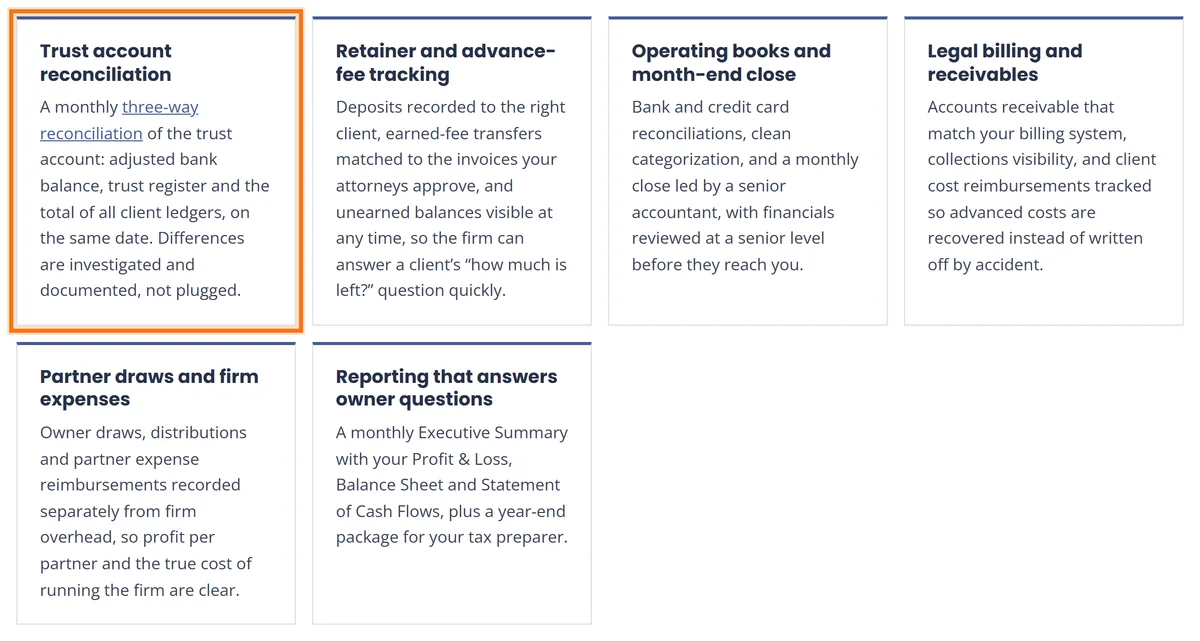
You receive a monthly Executive Summary with a Profit & Loss, Balance Sheet and Statement of Cash Flows. At year-end, we provide a package for your tax preparer. Together, those reports show what the firm earned and where cash went, while the trust reconciliation documents whose money you are holding.
Two people touch the work. Our bookkeeper, Inday Reo Pedere, who has 7 years of experience in QuickBooks Online, posts trust deposits and disbursements to the right client matter. Senior Accountant Erin Marchbanks, who has 15+ years of experience, reviews the trust reconciliation and the financials before delivery. Our founder and CEO, LaTara Scott, MBA, is a QuickBooks Online ProAdvisor. The person who records an entry is not the person who signs off on it.
We are a woman-owned bookkeeping, accounting and fractional CFO firm based in Dallas-Fort Worth. Meetings are by video or phone, and we work through secure cloud access with multi-factor authentication, role-based permissions and encrypted file sharing. We are bookkeepers, not lawyers: we do not give legal advice, and you keep signing authority and responsibility for the trust account.
What actually drives a law firm’s monthly bookkeeping fee?
Revenue alone tells a provider very little. It does not say how many deposits have to be assigned to a matter or how many disbursements need supporting records. A solo immigration practice that earns flat fees in stages and holds filing-fee advances can have more trust bookkeeping than a higher-revenue firm with little trust activity. A contingency practice can have a heavy reconciliation month when settlements close, even if its open-matter count barely changes.
| Cost driver | Why it adds work | What to tell the provider |
|---|---|---|
| Bank, credit card and trust accounts | Each account is reconciled every month. A separate interest-bearing client trust account adds its own reconciliation. | List operating accounts, cards, IOLTA accounts and any separate client trust accounts. |
| Open matters holding client funds | Each matter with money in trust needs its own ledger and a balance someone can explain. | Count the open matters with a trust balance today. |
| Trust transaction volume | Every deposit and disbursement is posted to the right client matter. | Give typical monthly counts and flag months with unusually heavy activity. |
| Settlement disbursements | Each payment is tied to the client and the payee, with a settlement statement on file. | Say how often settlements close and how many payees are usually involved. |
| Staged fees and client costs | Fee transfers follow approved invoices. Filing-fee advances and costs the firm fronts are tracked until used or reimbursed. | Describe when fees are earned, which costs you advance and how you track recovery. |
| Billing software and QuickBooks | Differences between the two systems take time to trace and resolve. | Name your systems and flag any balances you already know disagree. |
| Partners, payroll and reporting | Draws, distributions, reimbursements, payroll, budgets and forecasts are different kinds of work. | Give the partner count, payroll headcount and the reports or meetings you want. |
| Condition of the records | Missing ledgers and old differences have to be researched before normal monthly work can start. | Share the last month with a completed three-way reconciliation and any known gaps. |
How to read this table: the first five rows are trust work, and they are where two firms of the same size differ most. If your volume swings with settlement activity, describe a typical month and a busy one, so the proposal reflects how your practice really operates. The last row decides whether you will also see a one-time cleanup fee.
What must a monthly IOLTA reconciliation include for the price to mean anything?
Ask every provider what they mean by “trust reconciliation.” A bank reconciliation can show that the bank and the trust register agree while a deposit is still assigned to the wrong client. A three-way reconciliation adds the client ledger total, and the work behind it includes reviewing individual balances and tracing exceptions.
- Find the adjusted bank balance. Start with the trust bank statement at month-end and account for timing items such as outstanding checks and deposits in transit.
- Compare it with the trust register. Use the register balance for the same date. Trace any difference to the entries and supporting records.
- Add the individual client ledger balances. Compare the total for that same date with the adjusted bank balance and the register. Investigate and document differences before making corrections.
A matching total still calls for a look at the individual ledgers. A client ledger below zero, an unidentified deposit, earned fees still sitting in trust, or a balance that has not moved in months can each require an attorney’s decision. We flag those items and document what we find; the decision stays with you. Our guide to IOLTA three-way reconciliation shows what the finished report contains.
In Texas, client trust funds are governed by Rule 1.15 of the Texas Disciplinary Rules of Professional Conduct, “Safekeeping Property.” Older references cite Rule 1.14, the number used until October 1, 2024. The rule requires complete trust account records to be kept for five years after the representation ends. It does not set a reconciliation schedule, but the State Bar’s A Lawyer’s Guide to Client Trust Accounts is direct about it.
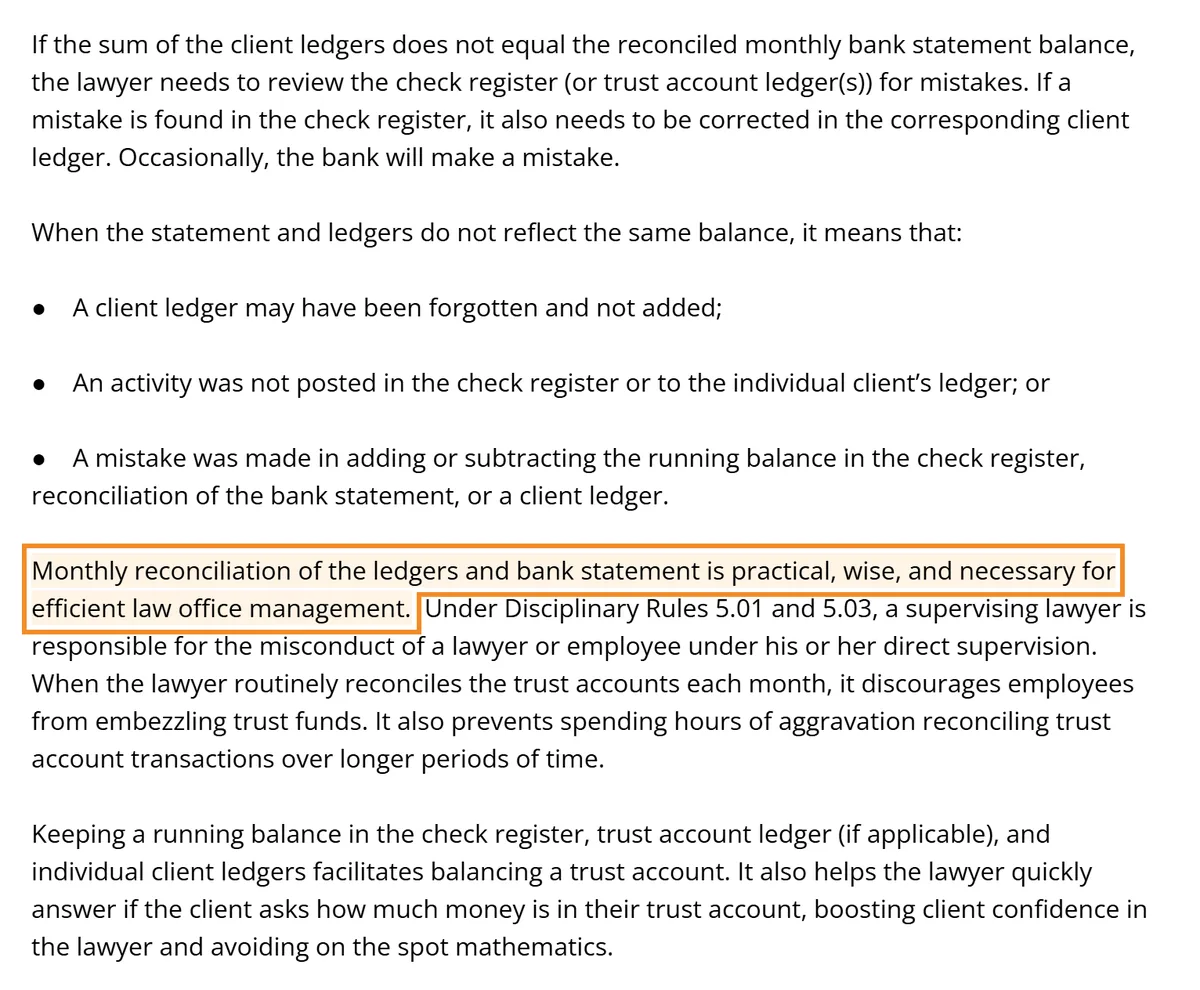
So when a quote says “bookkeeping” without naming client ledgers and a three-way reconciliation, the trust work is probably still on your desk. Our plain-language summary of the Texas IOLTA account rules covers what belongs in trust and what a grievance review looks at.
In-house hire, general bookkeeper or law firm bookkeeping team: what each really costs
A fair comparison puts the same work on each side. If your office manager would still maintain client ledgers under an outside plan, count that time. If a partner would review an employee’s reconciliation and cover their absences, count that time too.
| Option | What you pay for | Costs to add | Who reviews trust, and where gaps appear |
|---|---|---|---|
| In-house hire | Salary, employer payroll taxes and benefits | Recruiting, software seats, training, vacation coverage, and partner or staff time for oversight | Your firm assigns the reviewer and the backup. A single hire can leave one person posting and checking their own work. |
| General bookkeeper | The tasks listed in the monthly plan, usually centered on the operating books | Cleanup, payroll, unearned retainer adjustments, custom reports, meetings, or review, if excluded | Ask who maintains client ledgers and who reviews the three-way reconciliation. An operating bank close can leave trust work with your staff. |
| Law firm bookkeeping team | The quoted legal bookkeeping scope, including the trust and review work listed | Onboarding, historical cleanup, separately scoped services, and attorney time for approvals and decisions | Ask for the names or roles of the preparer and the reviewer, how exceptions are reported, and who covers an absence. |
How to read this table: the “Costs to add” column is what turns a low sticker price into a higher real one. An in-house hire can make sense when you have enough ongoing work and someone qualified to review it. A general bookkeeper can handle a defined operating scope if you already have a reliable trust process. A law firm bookkeeping team puts the operating close, the client ledgers and the trust review under one engagement, as long as the proposal names all three.
For an employee, add the employer’s 6.2% Social Security tax, up to the annual wage base, and 1.45% Medicare tax on wages. Federal unemployment tax is 6.0% on the first $7,000 of each employee’s wages, usually reduced to 0.6% by the state credit. In Texas, the 2026 taxable wage base for state unemployment tax is $9,000, and most new employers pay a 2.7% rate. Our comparison of outsourcing versus in-house accounting walks through the rest of that calculation.
With a low-priced general plan, ask what happens when an advance fee is still unearned at month-end, or when the books need catch-up. Payroll, custom reports, meetings and a named reviewer often sit outside the plan. Get the trust scope in writing before you let the monthly price decide. For the same question outside the legal field, see how much bookkeeping costs in Dallas.
What will you pay once: onboarding and trust cleanup
At LUCI, onboarding is a one-time fixed fee stated in the proposal. It typically takes 2 to 4 weeks. We set up access to QuickBooks Online, your bank feeds and your billing or trust software, review the books and configure reporting.
Historical cleanup has its own scope. If the trust register and the client ledgers disagree, earlier reconciliations are missing, or the operating books are behind, we first identify what has to be brought current. For significant work, you get a separate fixed-fee proposal before we start. Ask which accounts and months it covers, and where the recurring engagement picks up. Our bookkeeping cleanup and catch-up page explains how those projects run.
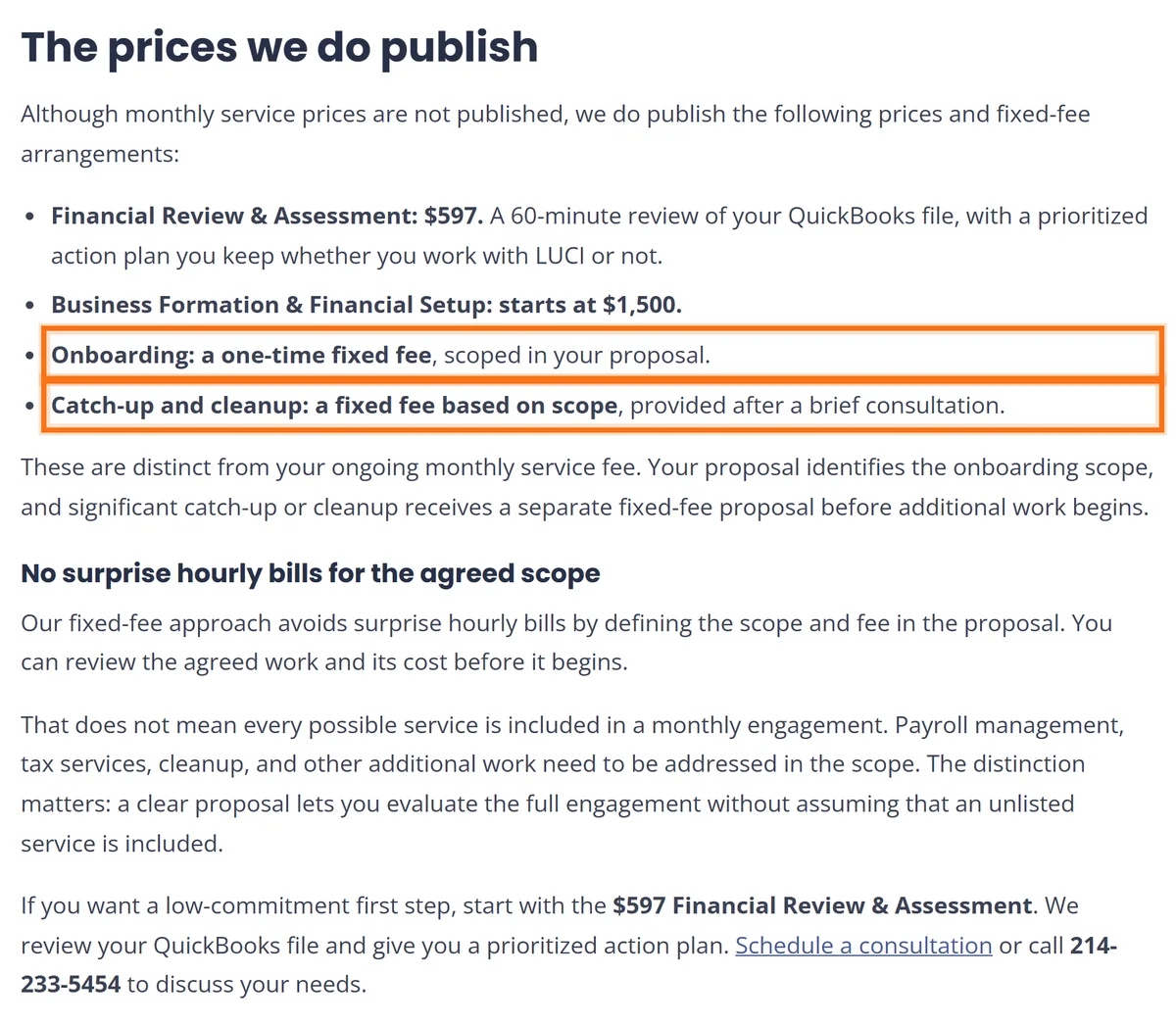
If you want a review before committing to ongoing service, our $597 Financial Review & Assessment is a 60-minute review of your QuickBooks file. You receive a prioritized action plan that is yours to keep whether or not you hire us.
How to compare two law firm bookkeeping quotes line by line
Put both written proposals side by side. For each line below, mark it included, separately priced or handled by our firm. Ask for a written answer wherever a proposal is silent, especially if it uses a broad label such as “trust accounting” or “full-service bookkeeping.”
- Accounts and workload. Confirm which operating, credit card, IOLTA and separate client trust accounts are covered. Ask what happens when you add an account or trust volume rises.
- Client ledgers and transfers. Identify who posts deposits and disbursements by matter, who matches earned-fee transfers to approved invoices, and who tracks unearned balances and client costs.
- Monthly trust reconciliation. Confirm that the provider compares all three balances for each trust account. Ask for a redacted sample that shows the cutoff date and how differences are documented.
- Review and follow-up. Identify who prepares the reconciliation, who reviews it and who brings issues to the attorney. Ask who covers the work when either person is away.
- Operating close and reporting. Confirm which statements you get and when, and whether billing balances, partner activity and the year-end package are included.
- Recurring and one-time charges. Compare monthly fees for equivalent work, then compare onboarding, cleanup and add-ons separately. Confirm what triggers a revised fee and how either side ends the engagement.
Before you sign, go back over everything marked handled by our firm. If the lower quote leaves matter posting or reconciliation review with your staff, decide who will do it and whether they have the time every month. That time is part of the cost of that quote. Our IOLTA compliance checklist for Texas law firms lists the daily, monthly and annual tasks someone has to own either way.
How LUCI sets your fee
We set a fixed monthly fee after discovery, based on transaction volume, the number of bank and trust accounts, payroll, your reporting and strategy needs, and how the work is divided with your team. Monthly fees start at $500. Higher fees are quoted in writing based on scope, and the agreed work comes with no hidden fees and no surprise hourly bills. The details are on our page about how LUCI prices bookkeeping.
- Core usually fits a solo attorney who needs monthly bookkeeping, reconciliations, senior review, monthly statements, the year-end package and email support.
- Growth adds quarterly financial review meetings, custom reporting, cash flow and trend reporting, and budget-to-actual reporting. It fits firms that want to see how actual results compare with the plan.
- Scale (CFO Advisory) adds a CFO-level partner, monthly strategy meetings, cash flow forecasting, pricing and margin analysis, and coordination with your CPA. A multi-attorney firm with partner draws, budgets and cash planning usually needs Growth or Scale.
Payroll management, accounts payable and receivable, 1099 preparation and QuickBooks Desktop to QuickBooks Online migration are scoped separately as add-ons. Tax preparation is available to ongoing clients, with returns prepared in partnership with our CPA. If a growing firm needs someone to own the close and the review, our controller services in Dallas sit inside the Growth and Scale levels.
There is no long-term contract. Engagements run month to month, with 30 days of written notice to end them.
Seven numbers to bring to the discovery call
A provider can only give a firm quote, instead of a wide range, when it knows the trust workload. Gather these before you call anyone, us included:
- The number of trust accounts: IOLTA and any separate client trust accounts.
- The number of open matters with a trust balance.
- A typical month’s count of trust deposits and disbursements, and a busy month’s.
- The name of your billing or trust accounting software.
- The last month with a completed three-way reconciliation.
- Payroll headcount.
- The number of partners taking draws or distributions.
If you are not sure whether a prior month was fully reconciled, say so and tell us which records you have. That answer is useful too: it tells us whether to plan for cleanup before monthly work begins.
For a written quote based on your firm’s workload, schedule a consultation or call 214-233-5454. If you would rather start on your own, take the free 7-question Financial Operations Assessment.
Frequently asked questions
Is IOLTA reconciliation included in LUCI’s monthly fee?
Yes. Our monthly law firm bookkeeping includes a three-way trust reconciliation. We compare the adjusted bank balance, the trust register and the total of the individual client ledgers as of the same date. We investigate and document differences, and our senior accountant reviews the reconciliation before delivery.
What is LUCI’s minimum monthly bookkeeping fee?
Our minimum is $500 per month. After the discovery call, we put your fixed monthly fee and the agreed work in a written proposal. The fee depends on the accounts, transaction volume, payroll, reporting and level of support your firm needs.
Is trust account cleanup priced separately?
Yes. Significant trust cleanup or catch-up gets a separate fixed-fee proposal before work begins. The scope depends on the accounts and periods involved and the condition of the records. Onboarding also has its own one-time fixed fee, stated in your proposal.
Do solo attorneys pay less than multi-attorney firms?
Often, but not always. A solo attorney with fewer accounts, lighter trust activity and standard reporting usually has a smaller scope. A solo practice with many funded matters or frequent settlement disbursements can require more work. We price the work your firm needs across trust, operating books and reporting.
Can you work with our legal billing or trust software?
We keep your operating books in QuickBooks Online and reconcile trust against the individual client ledgers in your billing or trust accounting system. Tell us which system you use during discovery so we can discuss access and how records will be matched across systems.
Does LUCI require a long-term bookkeeping contract?
No. Our engagements run month to month, with 30 days of written notice to end service. Your proposal states the fixed monthly fee, the work it covers and the one-time onboarding fee. Any significant cleanup is quoted separately before that work starts.
Get a fixed fee for your firm’s books and trust records
LUCI Financial Solutions keeps the operating books and the IOLTA records for Dallas–Fort Worth law firms, with a three-way reconciliation every month and a senior review before anything reaches you. See our law firm bookkeeping services or start with a consultation.