

Short answer: Yes, for most Dallas businesses doing $2 million to $10 million a year, a fractional controller is worth it once the books need more review than a bookkeeper can give but the work does not fill a full-time controller’s week. You pay for a firm close date, reconciled balances, reports that tie out, controls and cash planning. Revenue is only the starting point: complexity decides.
Key takeaways
- A bookkeeper records activity. A controller checks that it is complete and correct, and owns the process behind the reports.
- A fractional controller fits when you need someone accountable for the books without adding a full-time controller to payroll.
- Compare a hire’s full cost: salary plus employer payroll taxes, benefits, recruiting, software, training and vacation coverage.
- After 90 days, judge it on evidence: a working close calendar, reconciled balances, useful reports and fewer open questions.
- At LUCI, controller-level work starts in the Growth plan, priced as a fixed monthly fee after a discovery call, month to month.
Between $2 million and $10 million, many owner-led companies in Dallas, Plano and Frisco hit the same wall. The bookkeeper still keeps up with the entries, but reports change after they are delivered, cash surprises the owner, and the CPA spends year-end fixing what nobody checked. This guide shows how to tell whether a fractional controller fixes that for your business, how it compares with hiring one, and how to measure it once it starts.
What goes wrong when a bookkeeper is the only financial checkpoint?
A bookkeeper can record transactions accurately while the overall reporting process still falls short. The issue is often missing review, unclear responsibility, or a reporting system that no longer matches the business.
A bank account can reconcile while expenses remain in the wrong categories. A loan payment can clear while principal and interest are recorded incorrectly. An invoice can appear in receivables even though the underlying payment was never applied correctly.
These errors affect decisions. The owner may see profit without understanding why cash is tight, compare months that include different accounting treatments, or approve spending before seeing upcoming obligations.
Controller oversight addresses the process behind those results. It checks reconciliations, accruals, supporting balances, reporting consistency, and whether open questions are resolved before reports go out.
| What you are seeing | What a bookkeeper alone generally handles | What controller oversight adds |
|---|---|---|
| Reports keep changing after delivery | Recording and updating transactions | A close calendar, review checklist, and firm finalization date |
| Profit and available cash seem disconnected | Recording receipts and payments | Accrual review, cash reporting, and cash planning |
| Receivables or payables contain unexplained balances | Entering invoices, bills, and payments | Aging reports checked against the ledger |
| Errors reach the owner or CPA | Correcting entries when identified | Review before reports are delivered |
| Several entities exchange money | Recording each entity’s activity | Intercompany balances and entries checked together |
| One person controls recording and approval | Performing assigned bookkeeping tasks | Approval rules, access limits, and separate review |
Read this table by looking for recurring gaps. If the same questions return each month, adding more transaction processing may leave the underlying problem unresolved. Someone needs responsibility for the quality of the finished books.
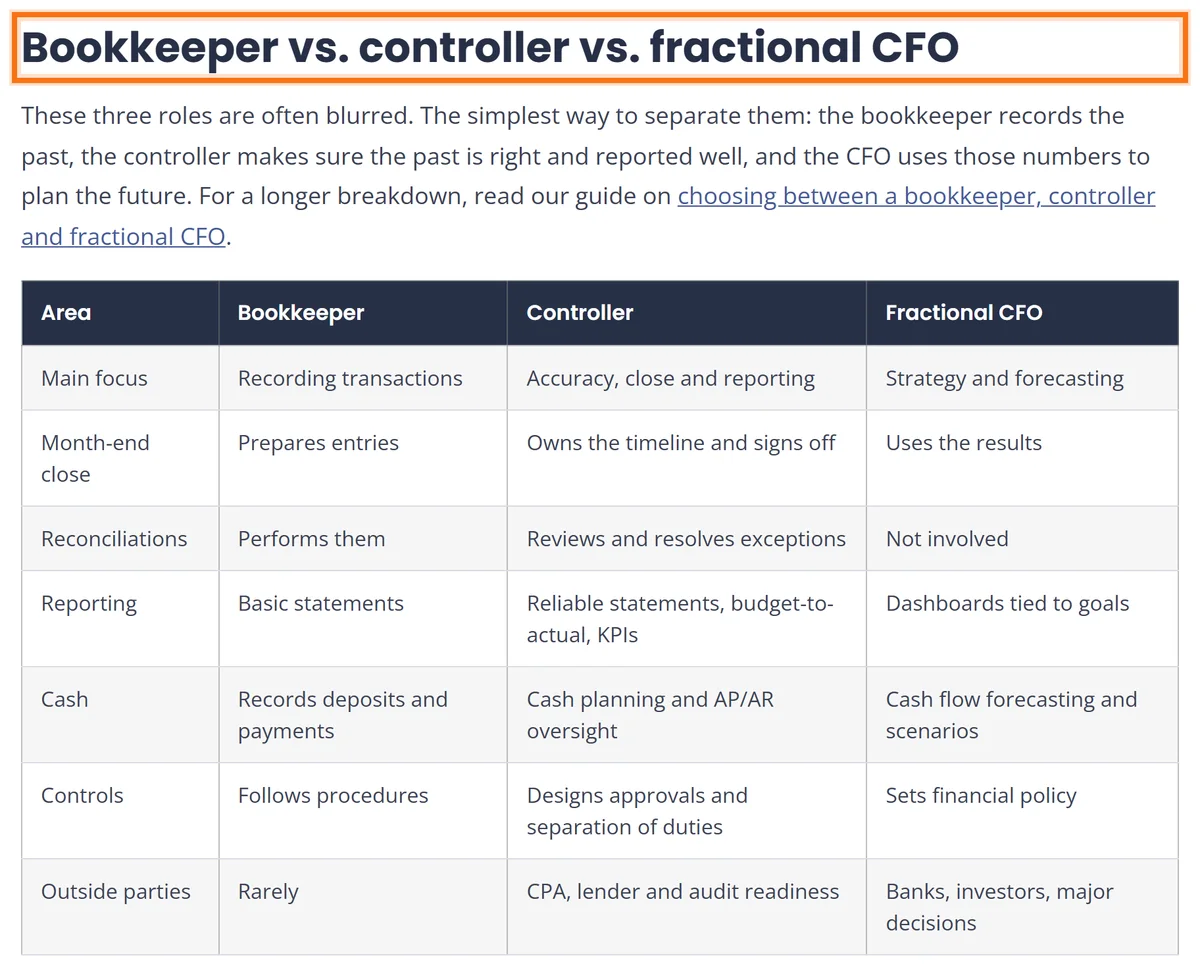
The distinction is explained further in our guide to bookkeeper vs. controller vs. fractional CFO. A CFO uses dependable numbers to plan the future; a controller helps make those numbers dependable.
Does revenue alone tell you when you need a controller?
No. A straightforward business near the upper end of this revenue range may have fewer accounting demands than a smaller business with several entities, locations, or project structures.
Look at how money moves and how many judgments the books require. More bank accounts, payroll activity, financing, unpaid invoices, and entity transfers create more places for errors or delays.
Our guide to what has to change in the books past $1 million addresses this shift. As the business grows, financial work needs a repeatable process with clear ownership.
Some industries need oversight early:
- Law firms: Operating and trust accounts must remain strictly separate, with trust reconciliations reviewed monthly.
- Medical and dental practices: Several locations or entities need consistent accounting and reporting that supports meaningful comparisons.
- Multi-entity businesses: Intercompany entries must balance across the affected entities.
- General contractors: Project accounting needs enough detail to connect financial results with the work being performed.
For a group practice with locations in Dallas and Plano, a combined profit figure may leave important questions unanswered. The owner may need entity-level reports and consistent expense treatment before comparing performance.
Similarly, money transferred between related businesses needs matching treatment on both sides. Our approach to multi-entity accounting includes checking those relationships rather than reviewing each set of books in isolation.
The practical test is whether your current process can explain the balances and produce reports you can use. If the owner must rebuild that explanation every month, the business has an oversight gap.
Fractional controller vs. a full-time hire for a Dallas company
A full-time controller can make sense when the business needs sustained daily financial leadership and enough ongoing work to support the position. Fractional oversight fits when the need is recurring but does not require a full-time role.
Bookkeeping remains necessary under either model. Hiring a controller does not eliminate transaction entry, account maintenance, or the need for accurate source information.
| Factor | Fractional controller | Full-time controller hire | Bookkeeper only |
|---|---|---|---|
| Coverage | Defined recurring oversight and meetings within the agreed scope | Dedicated employee availability, with responsibilities set by the employer | Day-to-day transaction work within the bookkeeping scope |
| Separation of duties | Can provide separate preparation and review; LUCI uses a team structure | Requires other staff and approval rules to support separation | Needs an additional reviewer to create a separate checkpoint |
| Cost structure | Provider fee and onboarding; LUCI quotes a fixed monthly fee | Salary, employer taxes, benefits, recruiting, systems, training, and coverage | Bookkeeping cost, with additional review arranged separately |
| Continuity when someone leaves | Depends on team coverage and documented processes | Requires replacement and handoff planning | Depends on the bookkeeper’s documentation and backup |
| Lender/CPA readiness | Can maintain reconciled reports and supporting schedules within scope | Can own readiness if included in the role | May need further review before delivery |
Use this comparison to match the workload with the operating model. A full-time employee brings dedicated capacity; a fractional arrangement needs clear boundaries around availability, deliverables, and responsibility.
Ask who completes the work between meetings. A provider who discusses reports but leaves close ownership unclear may not fill the controller gap.
At LUCI, we do not sell a separate controller package. Controller-level work sits within Growth and Scale, with the right scope established during discovery.
If your larger need is forecasting, strategic decisions, and a continuing financial conversation, review our fractional CFO services in Dallas. Those services build on reliable accounting.
What does a full-time controller really cost beyond salary?
A fair hiring comparison starts with the proposed salary and adds the employer’s other obligations. We do not use an assumed controller salary because the responsibilities and candidate requirements must be defined first.
Federal employer payroll taxes include Social Security at 6.2%, up to the annual wage base, and Medicare at 1.45% of wages. These are employer costs in addition to salary.
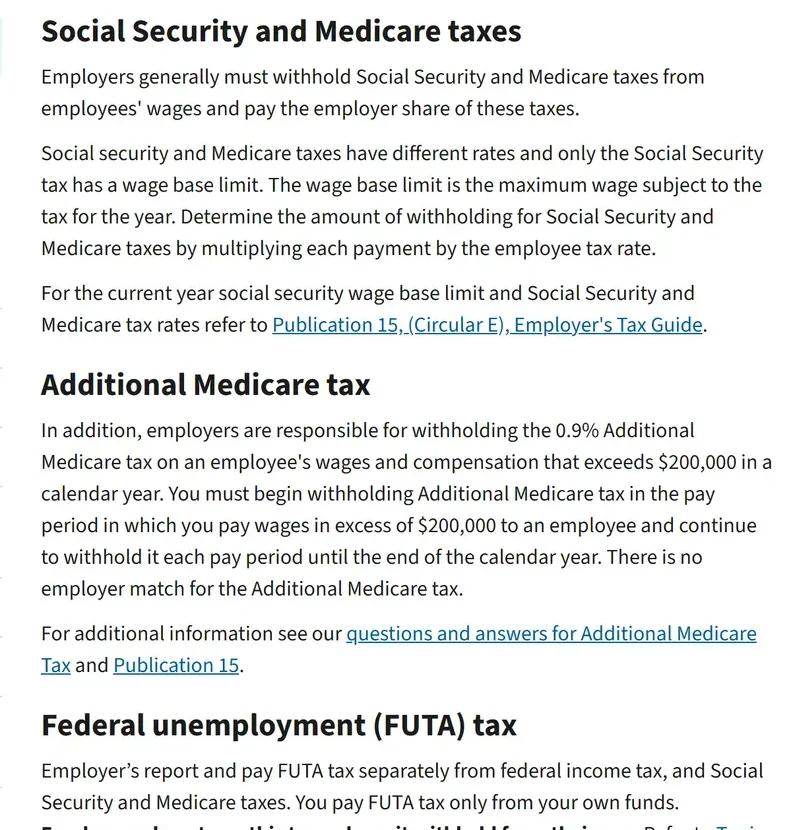
Federal unemployment tax, or FUTA, is 6.0% on the first $7,000 of each employee’s wages. The state credit usually reduces that rate to 0.6%, subject to eligibility.
For Texas unemployment tax, the 2026 taxable wage base is $9,000, and the rate for most new employers is 2.7%. An established employer should use its assigned rate when building its hiring budget.
Benefits, recruiting, software seats, training, and covering vacations come on top. Include management time for hiring, onboarding, and reviewing the role’s performance, even when it does not appear as a separate vendor invoice.
Build the comparison in this order:
- Define the job. Identify close ownership, reporting, cash planning, staff supervision, and any daily operating responsibilities.
- Calculate employer taxes. Apply the relevant wage bases, rates, and credits to the proposed compensation.
- Add the supporting costs. Include benefits, recruiting, software, training, and absence coverage.
- Compare equivalent work. Check which responsibilities a fractional proposal includes and which remain with your employees.
- Separate transition work. Existing cleanup and new-system setup should be visible rather than buried in an ongoing comparison.
A monthly provider fee and an employee’s salary are different measures. Compare the full cost of obtaining the required work, along with the time and capacity each option gives you.
How can you tell whether it is paying off after 90 days?
Use the first 90 days to judge whether financial operations are becoming more dependable and useful. Revenue growth alone is a poor test of accounting oversight, and a tidy report does not prove the underlying balances are right.
Set the evaluation criteria at the beginning. Distinguish onboarding and cleanup work from the recurring process you expect once the books are ready.
- Establish the starting condition. Identify unreconciled accounts, missing information, unresolved balances, and reporting delays. Record who owns each issue so progress can be checked against the original condition.
- Check whether the close is working. There should be a set calendar, a checklist, and a firm date when the books are final. Review our month-end close checklist to understand the work behind that deadline.
- Test report consistency. The Profit & Loss, Balance Sheet, and Statement of Cash Flows should tie out. Ask the team to explain a material balance and show how the supporting information connects to it.
- Review receivables, payables, and cash. Aging reports should match the ledger. The cash discussion should identify payroll and large payments before they become urgent, with assumptions explained.
- Inspect the controls. Confirm who records, approves, reviews, and controls access. Our guide to internal controls for a small business explains these checkpoints.
- Judge usefulness. Can the team explain budget variances and relevant KPIs? Can you answer business questions without rebuilding the reports yourself? Are unresolved issues visible, assigned, and moving toward resolution?
The result should be observable progress: fewer unexplained balances, a more reliable close, clearer cash needs, and reports that support decisions. If historical cleanup remains, ask what is complete, what remains, and how it affects current reporting.
How LUCI Financial Solutions handles controller work
We are a woman-owned bookkeeping, accounting, and fractional CFO firm based in Dallas-Fort Worth. We serve established service businesses, including professional services firms, agencies, law firms, consultants, medical and dental practices, and general contractors.
Our controller services in Dallas provide outsourced, month-by-month oversight for companies that have outgrown a solo bookkeeper. We work virtually through secure cloud systems and scheduled video or phone meetings. Owners in Dallas, Plano, Frisco, Richardson, and Addison do not need an office visit to work with us.
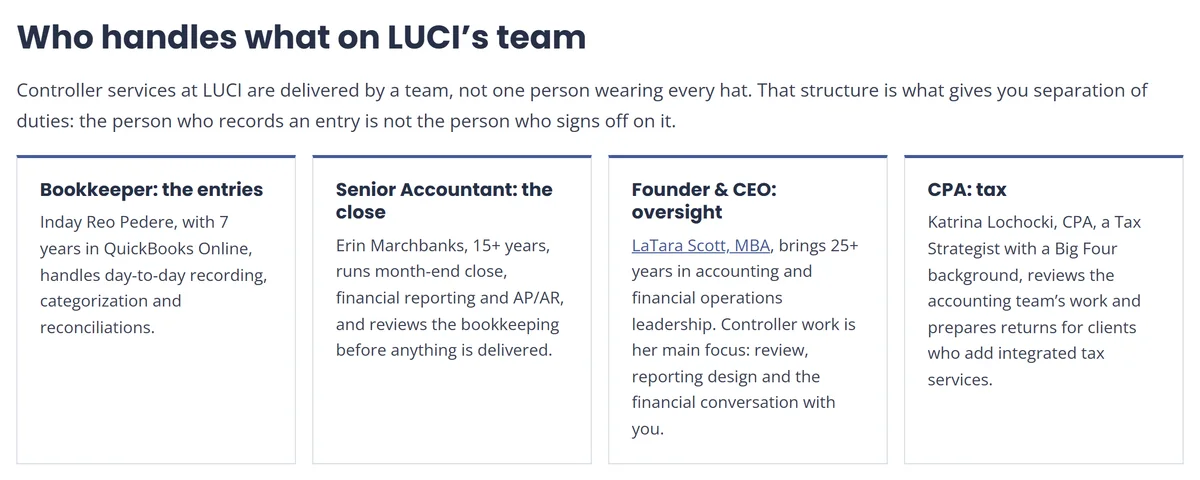
Our team structure matters. Inday Reo Pedere, our bookkeeper with 7 years in QuickBooks Online, handles day-to-day recording, categorization, and reconciliations. Senior Accountant Erin Marchbanks brings 15+ years of experience and runs month-end close, financial reporting, and AP/AR, reviewing the bookkeeping before delivery.
Our founder and CEO, LaTara Scott, MBA, oversees review, reporting design, and the financial conversation with the owner. Katrina Lochocki, CPA, our Tax Strategist with a Big Four background, reviews the accounting team’s work and prepares returns for clients who add integrated tax services.
The person recording an entry is not the person signing off on it. That separation of duties creates a review process you can identify and evaluate.
If you already recognize the gap, schedule a consultation or call 214-233-5454. We can discuss whether you need monthly bookkeeping, controller-level oversight, bookkeeping cleanup, or fractional CFO advisory.
Our Core tier includes monthly bookkeeping, reconciliations, senior review, and a monthly financial package. Growth adds quarterly financial review meetings, custom reporting, cash flow visibility and trend reporting, budget-to-actual reporting, and financial observations and recommendations. This is where controller-level oversight starts.
Scale, our CFO Advisory tier, adds monthly strategy meetings, senior accountant review with a monthly financial narrative, a KPI dashboard, cash flow forecasting, and coordination with the CPA.
The written scope should connect those services to your actual books. Controller work can include close ownership, bookkeeping review, reconciliations and accruals, financial statements that tie out, AP/AR oversight, controls, and lender or CPA readiness. Multi-entity work should be identified explicitly.
Pricing depends on transaction volume, number of accounts, payroll, and the amount of reporting and strategy needed. We confirm a fixed monthly fee after discovery, with a one-time onboarding fee.
Significant bookkeeping cleanup receives its own fixed-fee proposal first. That distinction matters because repairing old balances is different from maintaining an orderly monthly process.
Onboarding typically takes 2 to 4 weeks, covering access, book review, workflows, and reporting setup. Service runs month to month, with 30 days of written notice to end it.
What to ask any provider before you sign
Start with ownership and evidence. A useful answer names the responsible role, the deliverable, and how completion is reviewed.
Ask these questions during discovery:
- Who owns month-end close? Establish who drives the calendar, follows up on missing information, and approves final reports.
- Who reviews the preparer’s work? Ask how separation of duties operates in practice.
- Which accounts and statements are included? Confirm bank, credit card, loan, and clearing accounts, accruals, and the financial package.
- How are AP/AR and cash handled? Clarify aging review, ledger agreement, cash planning, and any owner responsibilities.
- What changes for our industry or entities? Discuss trust accounting, project accounting, locations, or intercompany activity as applicable.
- What is outside the fee? Identify cleanup, tax services, additional reporting, and changes in scope.
- What happens during an absence or departure? Ask about documentation, backup, and access continuity.
- What will we evaluate after 90 days? Agree on process and reporting evidence before service begins.
For an owner who wants a defined starting review, we offer a $597 Financial Review & Assessment: a 60-minute review of the QuickBooks file and a prioritized action plan.
To discuss ongoing support, schedule a consultation or call 214-233-5454. If you are not ready for a call, complete our free 7-question Financial Operations Assessment.
Frequently asked questions
Is $2 million in revenue enough to need a controller?
It can be. Revenue alone does not decide the need. Several entities, complex receivables, project accounting, trust accounts, or recurring reporting problems can make controller oversight useful.
Does a fractional controller replace my bookkeeper?
Not necessarily. Bookkeeping records daily activity, while controller oversight checks completeness, accuracy, reporting, and the monthly process. LUCI provides these functions through a team.
Does LUCI offer a separate controller package?
No. Controller-level work starts within Growth and is also included within Scale. Scope and a fixed monthly fee are confirmed in a written proposal after discovery.
How long does onboarding take?
Onboarding typically takes 2 to 4 weeks for access, book review, workflows, and reporting setup. Significant cleanup receives a separate fixed-fee proposal first.
Do I need to visit an office in Dallas?
No. LUCI works virtually through secure cloud systems and scheduled video or phone meetings. No office visit is required.
Is there a long-term contract?
No. Service runs month to month, with 30 days of written notice to end it.
Find out if your business needs controller oversight
LUCI Financial Solutions gives growing Dallas–Fort Worth companies a senior team that owns the close and reviews the books, without a full-time controller on payroll. See our controller services in Dallas or start with a consultation.